THE JOURNAL / COLOSSUS LUX
Large Format Photography for Prints Measured in Feet
The phrase large format photography carries more than one meaning, and that causes real confusion when people are choosing work for a large wall. Traditionally it describes cameras that record on a large sheet of film or a large sensor, giving a very detailed negative or file. In everyday use today, many people mean something simpler: a photograph that can be printed large and still look right. Both meanings point to the same underlying question. How much real information is in the image, and how far can that information go before the print starts to show strain?
That question matters more than any camera name. A large print viewed from across a lobby and a large print viewed from two feet away in a hallway make different demands. Colossus Lux is the fine art practice of Vitor Lindo, based in Metro Atlanta. I build images for architectural scale, in feet not inches, using gigapixel photography, which means stitching hundreds of photographs into a single image. This article explains that process in plain terms, and what to look for in large photographic prints whether you buy my work or someone else’s.
What resolution actually means for a print
Resolution is often reduced to a single number, which hides the part that matters. What matters is how many points of real detail land on each inch of the finished print, and whether that detail was captured in the scene or invented afterward by software. Enlargement software can smooth a file and make it bigger. It cannot create texture that was never recorded. In grass, stone, water, and foliage, invented detail tends to look waxy or repetitive once you stand close.
A useful way to judge a large photography print is to think in viewing zones:
- From far across a room, overall tone, composition, and color carry the work, and modest detail is enough.
- From a normal standing distance, edges, transitions, and mid level texture have to be clean, with no visible softness in the main subject.
- From close, where a viewer stops to inspect the surface, fine texture decides whether the print feels photographic or printed.
Gigapixel photography, in plain terms
Gigapixel simply means an image made of a billion pixels or more. In practice, I make one by photographing a scene in a careful grid, frame by frame, with each frame overlapping the next. Software and manual checking then align those frames into one continuous image. The horizon has to match, moving water and shifting light have to be handled, and any frame with a flaw can compromise the section around it. It is slow field work followed by slower desk work.
The point is not the number itself. The point is choice. With that much captured information, a section of the scene can become a large print on its own, or the whole scene can fill a tall wall without the texture falling apart. It also allows honest cropping. If a wall needs a narrower proportion than the original scene, I can take that proportion from the full image and still have a file with real detail, rather than stretching a small file to fit.
My cameras include a Fujifilm GFX 100S II and a Phase One IQ180 back, both chosen for the quality of the single frames that go into a stitched image. Gear is secondary here. A well made stitched image from careful field work will outperform a single hurried frame from a more expensive camera, because the method, the light, and the patience in front of the scene decide more than the badge on the body.
Proof at scale: the Savannah installation
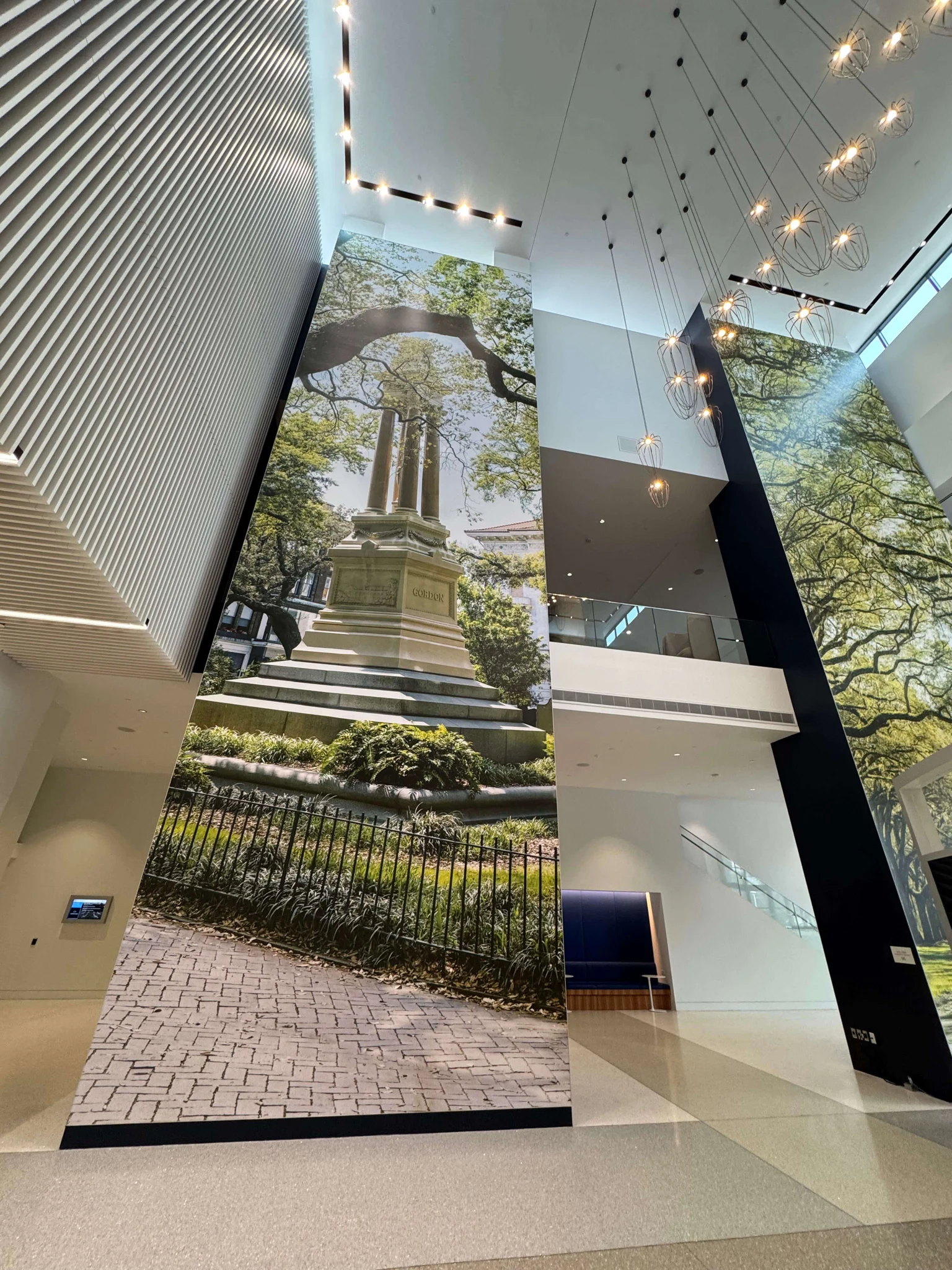
The clearest example of this approach in my own work is at the Savannah Convention Center. The installation consists of four permanent photographic works, each 15 feet wide by 53 feet tall, completed March 2025, and it is the largest photographic artwork ever installed in Savannah. I delivered the photography and print ready gigapixel files and worked closely with the venue team, architects, builders, fabricators and installers.
Works at that height change how you judge a file. A section that will sit forty feet above the floor can be evaluated mainly for tone and structure. A section at eye level, beside a doorway where visitors pass within inches, has to hold the finest detail in the scene. Planning which part of the image falls where in the room is part of making the work, not an afterthought once the print arrives. The large scale page shows the installation in context, and it is worth studying the eye level sections as closely as the full height view.
That experience shapes the smaller work as well. Even a six foot print for a home benefits from the same discipline: capture more than you need, check the file at full size in the areas people will actually see up close, and be honest about the largest size a given image should be offered at. Not every good photograph should become a very large print, and a responsible edition will say so.
Not every good photograph should become a very large print, and a responsible edition will say so.
Large format thinking in fine art landscape photography
In fine art landscape photography, scale interacts with subject in a way that is easy to underestimate. A detailed subject, such as live oaks with moss, a stone facade, or dune grass in low light, gains from size because size reveals structure that a small print compresses. A minimal subject, such as calm water under an even sky, gains in a different way. Size turns a quiet image into an environment. The print stops being a picture of a place and starts to set the temperature of the room.
Both directions can fail if the file is weak. Detail becomes noise, and quiet becomes emptiness with visible banding in the sky or water. When you evaluate a landscape image for a large wall, ask to see a full size section, sometimes called a one hundred percent crop, of the most detailed area and of the smoothest area. Those two samples tell you more than a polished room mock up, which is designed to flatter the image at a distance no viewer will keep.
Choosing the right size for your wall
Start with the wall, not with a standard size list. Measure the full wall, note doors, switches, vents, and trim, then decide the proportion the image should occupy. Height matters as much as width for large format work, because these images often carry foreground detail at the bottom and sky or canopy at the top. Cropping height away to fit a stock proportion can remove the part of the scene that gave it depth.
A few practical checks before you commit:
- View the image at the intended proportion, not only in its original shape, and confirm what the crop removes.
- Ask for the largest size the artist recommends for that specific image, and why.
- Confirm the finish, mounting, and total weight, and who is responsible for installation.
- Check how the surface handles the light in your room, especially glare from windows opposite the wall.
- For an edition, confirm the edition size, how sizes within the edition are counted, and what documentation you receive.
What I would ask any seller, including me
Ask how the image was captured, how large it has actually been printed before, and whether you can see that print or a full size section of the file. Ask what happens if the installed piece shows a flaw that was not visible in a small proof. These are ordinary, fair questions. Vague answers about resolution, or a refusal to show a detailed section, should slow a purchase down. The work may still be beautiful at a smaller size, and choosing that smaller size is not a compromise. It is matching the image to what it can honestly do.
Continue the conversation
If you are considering large photographic prints for a home, a hotel, or a public space in Atlanta, Savannah, or elsewhere, send the wall measurements and a photograph of the space. Tell me how close people will stand to the work. We can discuss which images can carry that scale and which should stay smaller, at Colossus Lux.